EGEB: Wind and solar now generate 10% of global power – Electrek

  • Wind and solar were the only power sources to show growth year on year, despite a 3% drop in demand.
  • Six former US EPA administrators are calling for a “reset” at the agency.
  • Siemens to test measuring EV charging consumption in New York with a Meter Integrated Charger.
  • Arcadia Power is committed to making clean energy work for the planet and your bank account — all without changing your utility company. Sign up to receive your $20 Amazon Gift Card.

Wind and solar growth

Wind and solar reached a record-high market share of 10% of global electricity in the first half of 2020, up by 14% compared to the same period in 2019, according to a new report from think tank Ember, which focuses on accelerating the global energy transition. This is despite a 3% drop in power demand globally due to the impact of COVID-19. Wind and solar have doubled their market share since the Paris Agreement was signed in 2015.

Many key countries now generate around a tenth of their electricity from wind and solar: China (10%), the US (12%), India (10%), Japan (10%), Brazil (10%), and Turkey (13%). The EU and UK were substantially higher with 21% and 33%, respectively; Germany rose to 42%. (Russia is the largest country to so far shun wind and solar, with just 0.2% of its electricity coming from them.) 

This year, for the first time, the world’s coal fleet ran at less than half of its capacity. Coal dropped by 8.3% in the global electricity mix from the first half of 2019 to the first half of 2020. The drop was led by major falls in the US (-31%) and the Europe Union (-32%). For the first time ever, the existing global coal fleet ran at less than half capacity. In the US, existing coal plants ran at less than a third of their capacity (32%). In contrast, China’s coal fell only 2%, meaning its share of global coal generation rose to 54% so far this year, up from 50% in 2019 and 44% in 2015. 

But here’s the important part: The global electricity transition is off track for 1.5 degrees.

Coal needs to fall by 13% every year this decade, and even in the face of a global pandemic, coal generation has only reduced 8% in the first half of 2020. The Intergovernmental Panel on Climate Change’s (IPCC) 1.5 degree scenarios shows coal needs to fall to just 6% of global generation by 2030, from 33% in the first half of 2020. The IPCC shows in all scenarios that most of coal’s replacement is with wind and solar. 

EPA reform

Six former US Environmental Protection Agency (EPA) administrators from both Democratic and Republican administrations joined a prominent group of former EPA officials to raise a bipartisan call for a new forward-looking direction at the EPA in an open letter.

Administrators Lee M. Thomas, William K. Reilly, Carol M. Browner, Christine Todd Whitman, Lisa P. Jackson, and Gina McCarthy discuss their concerns about the far-reaching impacts of climate change, new toxic hazards and other emerging health risks, and the disproportionate burdens that pollution and global warming place on lower-wealth communities, communities of color, and indigenous people. They write:

As EPA approaches its 50th anniversary this December, we believe the time has come to reset the future course for EPA in a new, forward-looking direction to address the environmental challenges we face today and those that lie ahead.

They cite a new report, “Resetting the Course of EPA,” from the Environmental Protection Network, a bipartisan group of more than 500 former EPA senior managers and employees. It provides a comprehensive set of recommendations to guide the EPA in addressing the most significant and emerging threats to public health and the environment.

It covers 10 action areas, from reducing emissions from vehicles, to safeguarding drinking water, to restoring science as the backbone of agency decision-making, to elevating environmental justice in all aspects of EPA’s work.

Siemens’ MIC

Siemens eMobility solutions announced this week that it will field test new EV charging technology, a Meter Integrated Charger (MIC), in New York. The MICs measure the quantity of electricity needed to charge EVs so that drivers, utilities, and others can track and manage consumption. The standard utility meter can be used to record the energy usage, and the meter will send the data back to the utility, which can then be shared with the customer. The data could be used to bill the EV on a separate rate in the future.

German multinational conglomerate Siemens is partnering with New York utility Con Edison to recruit up to 20 residential customers in New York with smart meters to participate in the project.

John DeBoer, head of Siemens eMobility solutions and Future Grid Business in North America, said:

Currently, for most customers who own EVs, EV energy consumption is mixed in with all other usage in the owner’s electricity bill, making it impossible to identify the energy costs from charging the EV versus the home’s air conditioning or lighting. With the MIC, the power used for the EV will show up separately. Siemens is working to promote EV adoption with our full range of charging equipment and solutions, and this could be a game-changer for EV drivers in understanding their fuel savings when they switch to EVs.

Con Edison will collect information on the charging habits of the participating customers and share it with Siemens. The project is supported by the New York State Energy Research and Development Authority.

FTC: We use income earning auto affiliate links. More.


Subscribe to Electrek on YouTube for exclusive videos and subscribe to the podcast.
[embedded content]

Scientists Turn Normal Red Bricks into Electricity-Storing Supercapacitors

Bricks are about as basic as architectural materials can get, yet these simple building blocks have hidden powers that can be leveraged to provide electricity, according to a new study. 

Scientists modified a common red brick—the same kind you’ll find on sale for under a dollar at your local hardware store—so that it could power a green LED light. This proof-of-concept for a “smart brick” reveals that brick technology, which dates back thousands of years, can be tweaked to have futuristic applications, including electrical conductivity and sensing capabilities. The results were published on Tuesday in Nature Communications.

Videos by VICE

“We have created a new brick that can be incorporated into your house that has the functionality of storing electrical energy,” said study co-author Julio D’Arcy, assistant professor of chemistry at Washington University in St. Louis, in a call. 

“We are thinking that sensing applications is a low-hanging fruit for these bricks,” he added.  

For years, D’Arcy and his colleagues have experimented with rust, the ubiquitous reddish film that forms on any structure that contains iron. Rust is normally seen as a corrosive nuisance, but D’Arcy’s team has shown that rusty iron oxides have useful properties for material science.

“We discovered that if you actually treat rust chemically, it actually becomes reactive,” D’Arcy explained. “So something that we typically think of as waste turns out to be a useful chemical for producing materials that can be used for storing energy.”

The pigment in red bricks is partially derived from rust, which inspired the researchers to take a closer look at the structural properties of bricks to see if they could be converted to an energy-storing device called a supercapacitor.

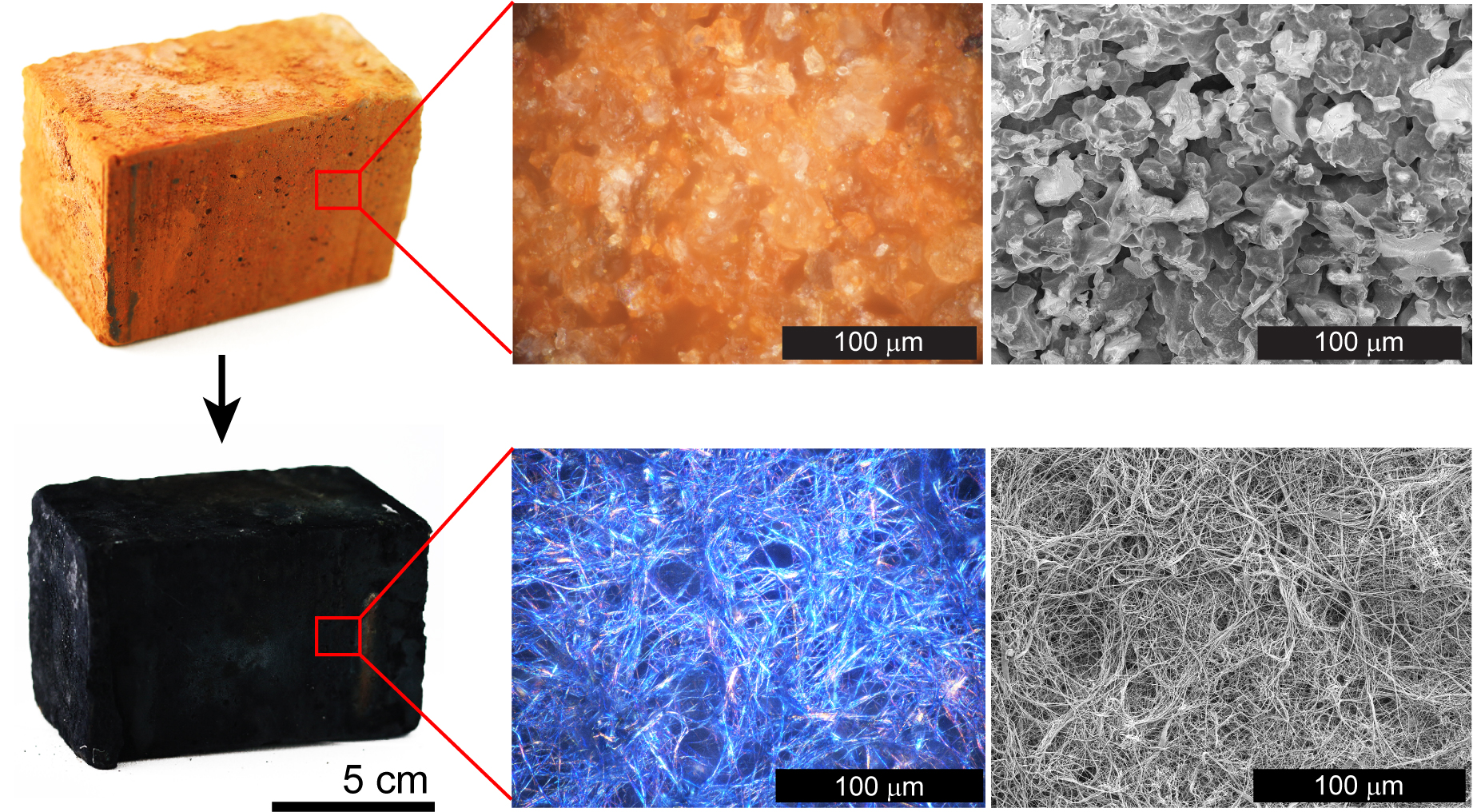
The intricate porous interiors of bricks turned out to be an ideal space to introduce sophisticated polymer coatings, which react with rust to increase the surface area and conductivity of bricks. 

These photos and microscope images show the structure of a common fired red brick before and after deposition of nanofibrillar coating that increases surface area within the brick. Image: The D’Arcy Laboratory in Washington University in St. Louis

As a result of the modifications, the team was able to engineer a prototype smart brick that stored enough energy to power the green light. The team is currently building on its findings by manufacturing specialized bricks with various metal oxides and polymer coatings. 

In addition to tinkering with conductivities and storage capacity, the researchers hope to demonstrate that air sensors or water purification systems could be integrated into the bricks.

“When the water runs down your rooftop and it goes through the brick, what if the water gets purified when it comes down and you finally collect it?” D’Arcy speculated. “We always think about purifying water on a filter. But what if the house was a filter?”

In the near-term, however, D’Arcy and his colleagues are focused on boosting the efficiency of these bricks so that they could be incorporated as a back-up power source in regular homes, such as an emergency lighting system.

“If we can increase the amount of energy that can be stored in one brick,” D’Arcy said, “we can scale up and use even less bricks.”

Scientists Turn Normal Red Bricks into Electricity-Storing Supercapacitors

The smart brick. Image: D'Arcy Laboratory, Department of Chemistry, Washington University in St. Louis ​

The smart brick. Image: D’Arcy Laboratory, Department of Chemistry, Washington University in St. Louis

Bricks are about as basic as architectural materials can get, yet these simple building blocks have hidden powers that can be leveraged to provide electricity, according to a new study. 

Scientists modified a common red brick—the same kind you’ll find on sale for under a dollar at your local hardware store—so that it could power a green LED light. This proof-of-concept for a “smart brick” reveals that brick technology, which dates back thousands of years, can be tweaked to have futuristic applications, including electrical conductivity and sensing capabilities. The results were published on Tuesday in Nature Communications.

“We have created a new brick that can be incorporated into your house that has the functionality of storing electrical energy,” said study co-author Julio D’Arcy, assistant professor of chemistry at Washington University in St. Louis, in a call. 

“We are thinking that sensing applications is a low-hanging fruit for these bricks,” he added.  

For years, D’Arcy and his colleagues have experimented with rust, the ubiquitous reddish film that forms on any structure that contains iron. Rust is normally seen as a corrosive nuisance, but D’Arcy’s team has shown that rusty iron oxides have useful properties for material science.

“We discovered that if you actually treat rust chemically, it actually becomes reactive,” D’Arcy explained. “So something that we typically think of as waste turns out to be a useful chemical for producing materials that can be used for storing energy.”

The pigment in red bricks is partially derived from rust, which inspired the researchers to take a closer look at the structural properties of bricks to see if they could be converted to an energy-storing device called a supercapacitor.

The intricate porous interiors of bricks turned out to be an ideal space to introduce sophisticated polymer coatings, which react with rust to increase the surface area and conductivity of bricks. 

These photos and microscope images show the structure of a common fired red brick before and after deposition of nanofibrillar coating that increases surface area within the brick. Image: The D’Arcy Laboratory in Washington University in St. Louis

These photos and microscope images show the structure of a common fired red brick before and after deposition of nanofibrillar coating that increases surface area within the brick. Image: The D’Arcy Laboratory in Washington University in St. Louis

As a result of the modifications, the team was able to engineer a prototype smart brick that stored enough energy to power the green light. The team is currently building on its findings by manufacturing specialized bricks with various metal oxides and polymer coatings. 

In addition to tinkering with conductivities and storage capacity, the researchers hope to demonstrate that air sensors or water purification systems could be integrated into the bricks.

“When the water runs down your rooftop and it goes through the brick, what if the water gets purified when it comes down and you finally collect it?” D’Arcy speculated. “We always think about purifying water on a filter. But what if the house was a filter?”

In the near-term, however, D’Arcy and his colleagues are focused on boosting the efficiency of these bricks so that they could be incorporated as a back-up power source in regular homes, such as an emergency lighting system.

“If we can increase the amount of energy that can be stored in one brick,” D’Arcy said, “we can scale up and use even less bricks.”

Highly efficient process makes seawater drinkable in 30 minutes

Access to clean, safe drinking water is a necessity that’s worryingly not being met in many parts of the world. A new study has used a material called a metal-organic framework (MOF) to filter pollutants out of seawater, generating large amounts of fresh water per day while using much less energy than other methods.

MOFs are extremely porous materials with high surface areas – theoretically, if one teaspoon of the stuff was unpacked it could cover a football field. That much surface area makes it great for grabbing hold of molecules and particles.

In this case, the team developed a new type of MOF dubbed PSP-MIL-53, and put it to work trapping salt and impurities in brackish water and seawater. When the material is placed in the water, it selectively pulls ions out of the liquid and holds them on its surface. Within 30 minutes, the MOF was able to reduce the total dissolved solids (TDS) in the water from 2,233 parts per million (ppm) to under 500 ppm. That’s well below the threshold of 600 ppm that the World Health Organization recommends for safe drinking water.

Using this technique, the material was able to produce as much as 139.5 L (36.9 gal) of fresh water per kg of MOF per day. And once the MOF is “full” of particles, it can be quickly and easily cleaned for reuse. To do so, it’s placed in sunlight, which causes it to release the captured salts in as little as four minutes.

While there’s no shortage of desalination systems in use or development, the team says that this new MOF is faster-acting than other techniques, and requires much less energy throughout the cycle.

Thermal desalination processes by evaporation are energy-intensive, and other technologies, such as reverse osmosis, has a number of drawbacks, including high energy consumption and chemical usage in membrane cleaning and dechlorination,” says Huanting Wang, lead author of the study. “Sunlight is the most abundant and renewable source of energy on Earth. Our development of a new adsorbent-based desalination process through the use of sunlight for regeneration provides an energy-efficient and environmentally-sustainable solution for desalination.”

The research was published in the journal Nature Sustainability.

Source: Monash University via Eurekalert

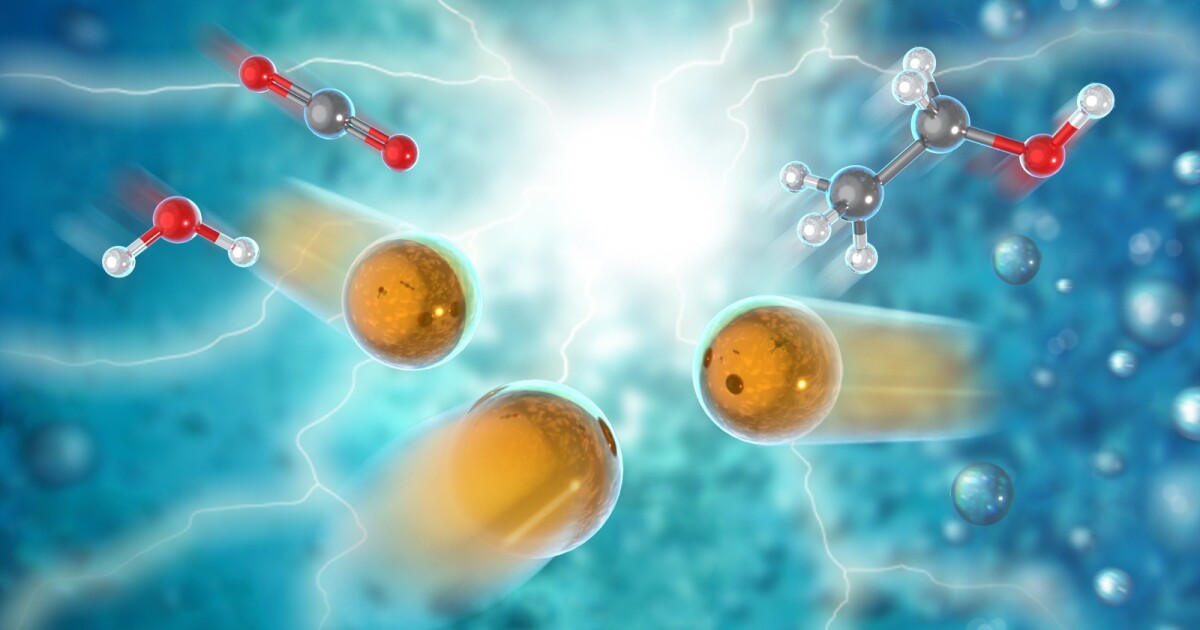
Researchers at the US Dept of Energy’s Argonne National Laboratory, working with Northern Illinois University, have discovered a new catalyst that can convert carbon dioxide and water into ethanol with “very high energy efficiency, high selectivity for the desired final product and low cost.”

The catalyst is made of atomically dispersed copper on a carbon-powder support, and acts as an electrocatalyst, sitting in a low voltage electric field as water and carbon dioxide are passed over it. The reaction breaks down these molecules, then selectively rearranges them into ethanol with an electrocatalytic selectivity, or “Faradaic efficiency”, higher than 90%. The team says this is “much higher than any other reported process.”

Once the ethanol is created, it can be used as a fuel additive, or as an intermediate product in the chemical, pharmaceutical and cosmetics industries. Using it as a fuel would be an example of a “circular carbon economy,” in which CO2 recaptured from the atmosphere is effectively put back in as it’s burned.

If the process is powered by renewable energy, which the researchers say it can be due to its low-temperature, low-pressure operation and easy responsiveness to intermittent power, then great; all you’re losing is fresh water, which is its own issue.

Realistically, you’re still a lot better off running an EV than a car fueled with gasoline using this ethanol as an additive. While its Faradaic efficiency might be excellent, its overall electrical efficiency won’t be; putting the same amount of energy into a battery will get more power to the wheels at the end of the day, because combustion engines are horribly inefficient in comparison to electric powertrains, and there will be additional significant power losses at this catalysis stage, as well as the industrial carbon capture and transport stages.

There’s no way of telling at this stage what the costs might be, either. There are already a number of synthetic fuels using catalytically captured carbon dioxide; Carbon Engineering is one firm that pulls CO2 from the air to create a synthetic crude that can be refined into high-purity aviation fuel, for example.

Such synthetic fuels need to compete with regular fossil gasoline on price, so without knowing how the Argonne team’s carbon-capture ethanol competes with bioethanol and other sources there, it’s hard to place this on the spectrum between “neat result that won’t see wide scale use” and “environmentally significant discovery.”

The paper is published in Nature Energy.

Source: Argonne National Laboratory

New catalyst rearranges carbon dioxide and water into ethanol fuel

Researchers at the US Dept of Energy’s Argonne National Laboratory, working with Northern Illinois University, have discovered a new catalyst that can convert carbon dioxide and water into ethanol with “very high energy efficiency, high selectivity for the desired final product and low cost.”

The catalyst is made of atomically dispersed copper on a carbon-powder support, and acts as an electrocatalyst, sitting in a low voltage electric field as water and carbon dioxide are passed over it. The reaction breaks down these molecules, then selectively rearranges them into ethanol with an electrocatalytic selectivity, or “Faradaic efficiency”, higher than 90%. The team says this is “much higher than any other reported process.”

Once the ethanol is created, it can be used as a fuel additive, or as an intermediate product in the chemical, pharmaceutical and cosmetics industries. Using it as a fuel would be an example of a “circular carbon economy,” in which CO2 recaptured from the atmosphere is effectively put back in as it’s burned.

If the process is powered by renewable energy, which the researchers say it can be due to its low-temperature, low-pressure operation and easy responsiveness to intermittent power, then great; all you’re losing is fresh water, which is its own issue.

Realistically, you’re still a lot better off running an EV than a car fueled with gasoline using this ethanol as an additive. While its Faradaic efficiency might be excellent, its overall electrical efficiency won’t be; putting the same amount of energy into a battery will get more power to the wheels at the end of the day, because combustion engines are horribly inefficient in comparison to electric powertrains, and there will be additional significant power losses at this catalysis stage, as well as the industrial carbon capture and transport stages.

There’s no way of telling at this stage what the costs might be, either. There are already a number of synthetic fuels using catalytically captured carbon dioxide; Carbon Engineering is one firm that pulls CO2 from the air to create a synthetic crude that can be refined into high-purity aviation fuel, for example.

Such synthetic fuels need to compete with regular fossil gasoline on price, so without knowing how the Argonne team’s carbon-capture ethanol competes with bioethanol and other sources there, it’s hard to place this on the spectrum between “neat result that won’t see wide scale use” and “environmentally significant discovery.”

The paper is published in Nature Energy.

Source: Argonne National Laboratory

How falling solar costs have renewed clean hydrogen hopes

The world is increasingly banking on green hydrogen fuel to fill some of the critical missing pieces in the clean-energy puzzle.

US presidential candidate Joe Biden’s climate plan calls for a research program to produce a clean form of the gas that’s cheap enough to fuel power plants within a decade. Likewise, Japan, South Korea, Australia, New Zealand, and the European Union have all published hydrogen roadmaps that rely on it to accelerate greenhouse gas reductions in the power, transportation, or industrial sectors. Meanwhile, a growing number of companies around the world are building ever larger green hydrogen plants, or exploring its potential to produce steel, create carbon-neutral aviation fuel, or provide a backup power source for server farms.

The attraction is obvious: hydrogen, the most abundant element in the universe, could fuel our vehicles, power our electricity plants, and provide a way to store renewable energy without pumping out the carbon dioxide driving climate change or other pollutants (its only byproduct from cars and trucks is water). But while researchers have trumpeted the promise of a “hydrogen economy” for decades, it’s barely made a dent in fossil fuel demand, and nearly all of it is still produced through a carbon polluting process involving natural gas.

The grand vision of the hydrogen economy has been held back by the high costs of creating a clean version, the massive investments into vehicles, machines and pipes that could be required to put it to use, and progress in competing energy storage alternatives like batteries.

So what’s driving the renewed interest?

For one thing, the economics are rapidly changing. We can produce hydrogen directly by simply splitting water, in a process known as electrolysis, but it’s been prohibitively expensive in large part because it requires a lot of electricity. As the price of solar and wind power continues to rapidly decline, however, it will begin to look far more feasible.

At the same time, as more nations do the hard math on how to achieve their aggressive emissions targets in the coming decades, a green form of hydrogen increasingly seems crucial, says Joan Ogden, director of the sustainable transportation energy pathway program at the University of California, Davis. It’s a flexible tool that could help to clean up an array of sectors where we still don’t have affordable and ready solutions, like aviation, shipping, fertilizer production, and long-duration energy storage for the electricity grid.

Falling renewables costs

For now, however, clean hydrogen is far too expensive in most situations. A recent paper found that relying on solar power to run the electrolyzers that split water can run six times higher than the natural gas process, known as steam methane reforming. 

There are plenty of energy experts who maintain that the added costs and complexities of producing, storing and using a clean version means it will never really take off beyond marginal use cases.

But the good news is that electricity itself makes up a huge share of the cost—upwards of 60% or more—and, again, the costs of renewables are falling fast. Meanwhile, the costs of electrolyzers themselves are projected to decline steeply as manufacturers scale up production, and various research groups develop advanced versions of the technology.

A Nature Energy paper early last year found that if market trends continue, green hydrogen could be economically competitive on an industrial scale within a decade. Similarly, the International Energy Agency projects that the cost of clean hydrogen will fall 30% by 2030.

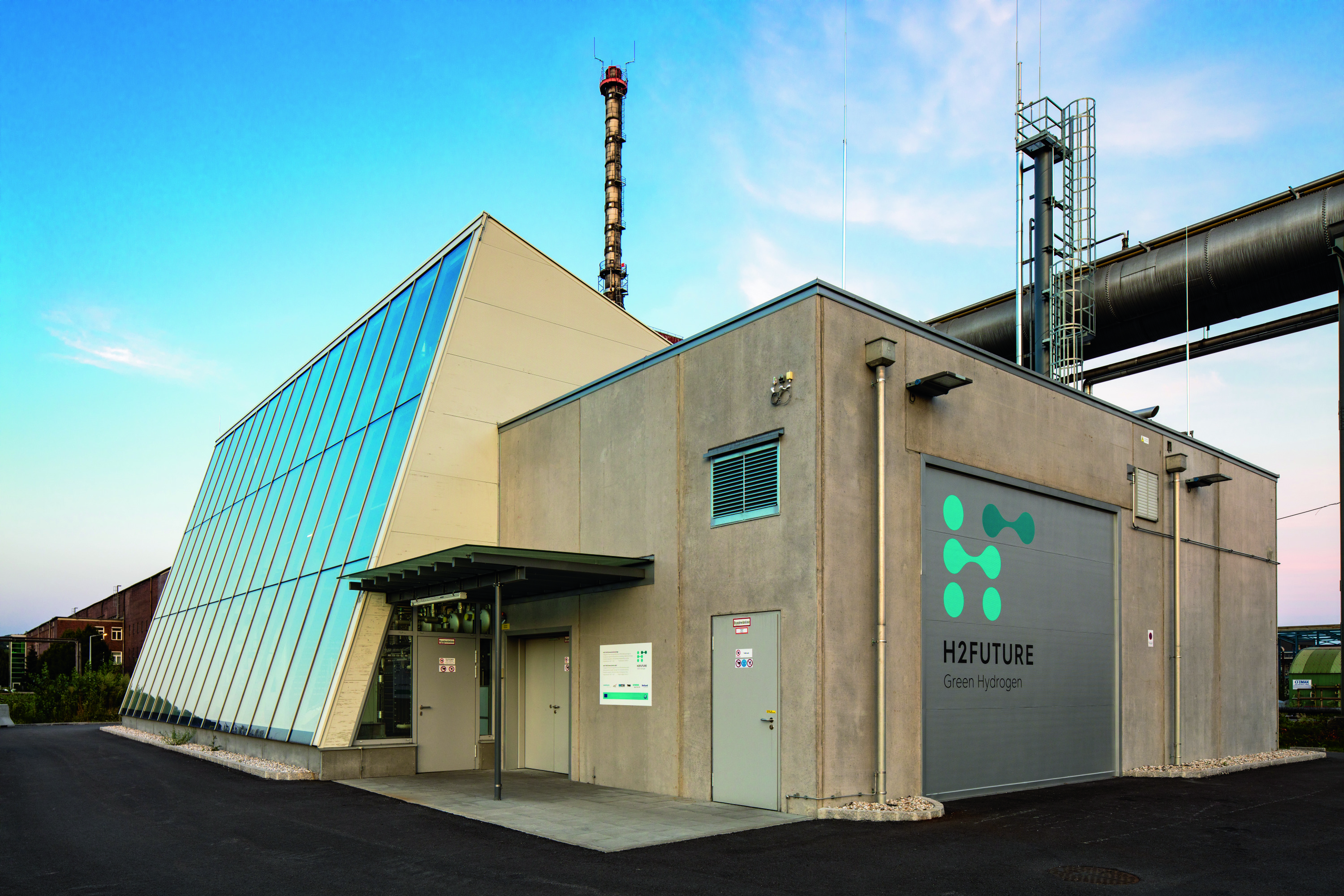
Voestalpine's H2H2FUTURE green hydrogen plant in Linz, Austria.
Voestalpine’s H2FUTURE green hydrogen plant in Linz, Austria.
VOESTALPINE

Green hydrogen may already be nearly affordable in some places where periods of excess renewable generation drive down the costs of electricity to nearly zero. In a research note last month, Morgan Stanley analysts wrote that locating green hydrogen facilities next to major wind farms in the US Midwest and Texas could make the fuel cost competitive within two years.

A June study from the US National Renewable Energy Laboratory found it may be closer to the middle of the century before hydrogen is the most affordable technology for long duration storage on the grid. But as fluctuating renewables like solar and wind become the dominant source of electricity, utilities will need to store up enough energy to keep the grid reliably working not just for a few hours, but for days and even weeks during certain months when those resources flag.

Hydrogen shines in that scenario compared to other storage technologies, because adding capacity is relatively cheap, says Joshua Eichman, a senior research engineer at the lab and co-author of the study. To increase the length of time that batteries can reliably provide electricity, you need to stack up more and more of them, multiplying the cost of every pricey component within them. With hydrogen, you just need to build a bigger tank, or use a deeper underground cavern, he says.

Putting hydrogen to use

For hydrogen to fully replace carbon-emitting fuels, we’d need to overhaul our infrastructure to distribute, store, and use it. We’d have to produce vehicles and ships with fuel cells that convert hydrogen into electricity, as well as fueling stations along ports and roads. And we’d need to stack up fuel cells or build or retrofit power plants to use the fuel to power the grid directly.

All of which will take a lot of time and money.

But there’s another scenario that sidesteps, or delays, much of this infrastructure overhaul. Once you have hydrogen, it’s relatively simple to combine it with carbon monoxide to produce synthetic versions of the fuels that already power our cars, trucks, ships, and planes. The industrial process to do so is a century old and has been used at various times by petroleum-strapped nations to make fuels from coal or natural gas.

Direct Air Capture pilot plant
Carbon Engineering’s pilot plant in Squamish, British Columbia.
CARBON ENGINEERING

Carbon Engineering, based in Squamish, British Columbia, is developing facilities that capture carbon dioxide from the air. The company plans to combine it with carbon-free hydrogen to make synthetic fuels. The idea is that the fuel will be carbon neutral, emitting no more carbon dioxide than was removed or produced in the process.

In a presentation at a Codex conference late last year, Carbon Engineering founder and Harvard professor David Keith said that falling solar prices should enable them to bring “air-to-fuels” to market for about $1 a liter (around $4 per gallon) in the mid-2020s–and that the price will continue to fall from there.

“The big news here is that this could be done with commodity hardware starting soon,” he said. “You could get to something like a million barrels a day of air-to-fuels synthetic hydrocarbon capacity, I think, soon after 2030, and after that there’s no obvious scaling limit.”

In effect, the process provides a way to convert fleeting, fluctuating solar power into permanently storable fuels that can fill the tanks of any of our machines. “This is about an energy pathway to … deal with the intermittency problem and deal with it in a way that allows you to power high-energy density needs around the world; allows you to fly airplanes across the North Atlantic,” Keith said.

The world is increasingly banking on green hydrogen fuel to fill some of the critical missing pieces in the clean-energy puzzle.

US presidential candidate Joe Biden’s climate plan calls for a research program to produce a clean form of the gas that’s cheap enough to fuel power plants within a decade. Likewise, Japan, South Korea, Australia, New Zealand, and the European Union have all published hydrogen roadmaps that rely on it to accelerate greenhouse gas reductions in the power, transportation, or industrial sectors. Meanwhile, a growing number of companies around the world are building ever larger green hydrogen plants, or exploring its potential to produce steel, create carbon-neutral aviation fuel, or provide a backup power source for server farms.

The attraction is obvious: hydrogen, the most abundant element in the universe, could fuel our vehicles, power our electricity plants, and provide a way to store renewable energy without pumping out the carbon dioxide driving climate change or other pollutants (its only byproduct from cars and trucks is water). But while researchers have trumpeted the promise of a “hydrogen economy” for decades, it’s barely made a dent in fossil fuel demand, and nearly all of it is still produced through a carbon polluting process involving natural gas.

The grand vision of the hydrogen economy has been held back by the high costs of creating a clean version, the massive investments into vehicles, machines and pipes that could be required to put it to use, and progress in competing energy storage alternatives like batteries.

So what’s driving the renewed interest?

For one thing, the economics are rapidly changing. We can produce hydrogen directly by simply splitting water, in a process known as electrolysis, but it’s been prohibitively expensive in large part because it requires a lot of electricity. As the price of solar and wind power continues to rapidly decline, however, it will begin to look far more feasible.

At the same time, as more nations do the hard math on how to achieve their aggressive emissions targets in the coming decades, a green form of hydrogen increasingly seems crucial, says Joan Ogden, director of the sustainable transportation energy pathway program at the University of California, Davis. It’s a flexible tool that could help to clean up an array of sectors where we still don’t have affordable and ready solutions, like aviation, shipping, fertilizer production, and long-duration energy storage for the electricity grid.

Falling renewables costs

For now, however, clean hydrogen is far too expensive in most situations. A recent paper found that relying on solar power to run the electrolyzers that split water can run six times higher than the natural gas process, known as steam methane reforming. 

There are plenty of energy experts who maintain that the added costs and complexities of producing, storing and using a clean version means it will never really take off beyond marginal use cases.

But the good news is that electricity itself makes up a huge share of the cost—upwards of 60% or more—and, again, the costs of renewables are falling fast. Meanwhile, the costs of electrolyzers themselves are projected to decline steeply as manufacturers scale up production, and various research groups develop advanced versions of the technology.

A Nature Energy paper early last year found that if market trends continue, green hydrogen could be economically competitive on an industrial scale within a decade. Similarly, the International Energy Agency projects that the cost of clean hydrogen will fall 30% by 2030.

Voestalpine's H2H2FUTURE green hydrogen plant in Linz, Austria.
Voestalpine’s H2FUTURE green hydrogen plant in Linz, Austria.
VOESTALPINE

Green hydrogen may already be nearly affordable in some places where periods of excess renewable generation drive down the costs of electricity to nearly zero. In a research note last month, Morgan Stanley analysts wrote that locating green hydrogen facilities next to major wind farms in the US Midwest and Texas could make the fuel cost competitive within two years.

A June study from the US National Renewable Energy Laboratory found it may be closer to the middle of the century before hydrogen is the most affordable technology for long duration storage on the grid. But as fluctuating renewables like solar and wind become the dominant source of electricity, utilities will need to store up enough energy to keep the grid reliably working not just for a few hours, but for days and even weeks during certain months when those resources flag.

Hydrogen shines in that scenario compared to other storage technologies, because adding capacity is relatively cheap, says Joshua Eichman, a senior research engineer at the lab and co-author of the study. To increase the length of time that batteries can reliably provide electricity, you need to stack up more and more of them, multiplying the cost of every pricey component within them. With hydrogen, you just need to build a bigger tank, or use a deeper underground cavern, he says.

Putting hydrogen to use

For hydrogen to fully replace carbon-emitting fuels, we’d need to overhaul our infrastructure to distribute, store, and use it. We’d have to produce vehicles and ships with fuel cells that convert hydrogen into electricity, as well as fueling stations along ports and roads. And we’d need to stack up fuel cells or build or retrofit power plants to use the fuel to power the grid directly.

All of which will take a lot of time and money.

But there’s another scenario that sidesteps, or delays, much of this infrastructure overhaul. Once you have hydrogen, it’s relatively simple to combine it with carbon monoxide to produce synthetic versions of the fuels that already power our cars, trucks, ships, and planes. The industrial process to do so is a century old and has been used at various times by petroleum-strapped nations to make fuels from coal or natural gas.

Direct Air Capture pilot plant
Carbon Engineering’s pilot plant in Squamish, British Columbia.
CARBON ENGINEERING

Carbon Engineering, based in Squamish, British Columbia, is developing facilities that capture carbon dioxide from the air. The company plans to combine it with carbon-free hydrogen to make synthetic fuels. The idea is that the fuel will be carbon neutral, emitting no more carbon dioxide than was removed or produced in the process.

In a presentation at a Codex conference late last year, Carbon Engineering founder and Harvard professor David Keith said that falling solar prices should enable them to bring “air-to-fuels” to market for about $1 a liter (around $4 per gallon) in the mid-2020s–and that the price will continue to fall from there.

“The big news here is that this could be done with commodity hardware starting soon,” he said. “You could get to something like a million barrels a day of air-to-fuels synthetic hydrocarbon capacity, I think, soon after 2030, and after that there’s no obvious scaling limit.”

In effect, the process provides a way to convert fleeting, fluctuating solar power into permanently storable fuels that can fill the tanks of any of our machines. “This is about an energy pathway to … deal with the intermittency problem and deal with it in a way that allows you to power high-energy density needs around the world; allows you to fly airplanes across the North Atlantic,” Keith said.

The Dawn of Wireless Electricity Is Finally Upon Us. Here’s How New Zealand Will Do It.

Estimated read time3 min read

Picture the street outside your home. Now erase the power lines. Imagine interstate highways without the unsightly cable towers that dot the expansive United States landscape. This could be the wireless future of energy if a partnership between New Zealand’s government and a startup called Emrod works out—and it all dates back to the wildest dreams of Nikola Tesla.

Wireless electricity sounds like science fiction, but the technology is already realized and primed for a utility-scale case study. And in this first-of-its-kind pilot program, Powerco—New Zealand’s second-largest electricity distributor—will test Emrod technology beginning in 2021.

“It sounds futuristic and fantastic but has been an iterative process since Tesla.”

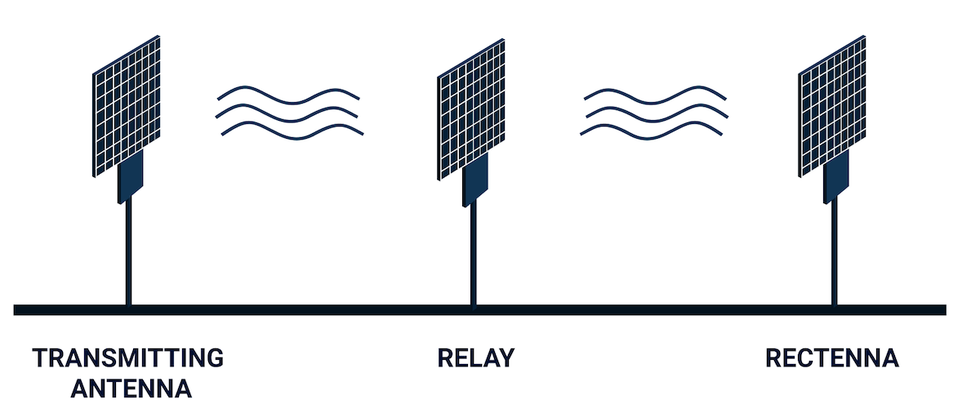
The companies plan to deploy the prototype wireless energy infrastructure across a 130-foot expanse. To make it possible, Emrod uses rectifying antennas, a.k.a. “rectennas,” that pass microwaves of electricity from one waypoint to the next: a solution well-suited to New Zealand’s mountainous terrain. Specialized square elements are mounted on intervening poles to act as pass-through points that keep the electricity humming along, and a broader surface area “catches” the entire wave, so to speak.

“We’ve developed a technology for long-range wireless power transmission,” says Emrod founder Greg Kushnir. “The technology itself has been around for quite a while. It sounds futuristic and fantastic but has been an iterative process since Tesla.”

The link to Nikola Tesla, Kushnir admits, is more of an imaginative, feel-good tale than a true genealogy. Tesla considered wireless power in the 1890s, as he labored over his breakthrough “Tesla coil” transformer circuit that generated alternating current electricity, but he couldn’t prove that he could control a beam of electricity across long distances. “The sheer fact that he could imagine it is remarkable, but the sort of technology he was looking to apply wouldn’t have worked,” Kushnir says.

Emrod, by contrast, can keep the beam of electricity tight and focused with two technologies. The first is transmission-related: Small radio elements and single wave patterns create a collimated beam, which means that the rays are aligned in parallel, and will not spread much as they propagate. Second, Emrod uses engineered metamaterials with tiny patterns that effectively interact with those radio waves.

Emrod’s wireless antennas are a medium, like a cable, meaning that their task is to simply connect an electrical supply to customers. Kushnir envisions placing Emrod technology on difficult terrain that links with the sunniest, windiest, or most hydro-friendly points on Earth as these often rural places have the widest gap in electrification.

By eliminating the need for long stretches of traditional copper wiring, Emrod says it can bring power to these regions, which can’t afford the kind of infrastructure that supports the power grid. There could be positive environmental ramifications to this, as well, since many sites that don’t have access to electricity end up leaning on diesel generators for energy.

There are even opportunities to support offshore wind and solar farms, Kushnir says, because the current friction point for those forms of renewable energy come down to the cost of transmission. In the Cook Strait—which connects the North and South Islands of New Zealand—offshore wind farms require expensive underwater cables, for instance.

At this point, Kushnir has enough corporate buy-in to take the next regulatory steps, and begin propagating Emrod’s technology. The real challenge, he says, will be to reassure and educate the public.

“We anticipate a lot of pushback similar to the stuff we’ve been seeing with 5G,” he says. “People push back on additional radiation around them, and it’s completely understandable.” But luckily, he says, Emrod’s controlled beam sheds no
radiation. It’s not a “spray” pattern like a cell phone antenna.

So if all goes well during the New Zealand pilot program in early 2021, wireless energy could quite literally be on the horizon in the U.S., too. As for when? That’s anybody’s guess.


Power Without Wires

emrod rectenna

Image courtesy of Emrod

To wirelessly conduct energy, Emrod generates electricity in a tight and focused beam in the non-ionizing Industrial, Scientific, and Medical band of the electromagnetic spectrum—the portion of the radio band that corresponds to Wi-Fi and Bluetooth frequencies.

From there, a transmitting antenna sends the power through various relay points to a “rectenna” that can safely transport the waves in the same frequency range as the microwave oven in your home. Meanwhile, tiny lasers monitor the rectennas to sense any obstructions between relay points. That way, there is no outside radiation, and
no birds are harmed in this transfer of power.

—Courtney Linder


🎥 Now Watch This:

Headshot of Caroline Delbert

Caroline Delbert is a writer, avid reader, and contributing editor at Pop Mech. She’s also an enthusiast of just about everything. Her favorite topics include nuclear energy, cosmology, math of everyday things, and the philosophy of it all.